




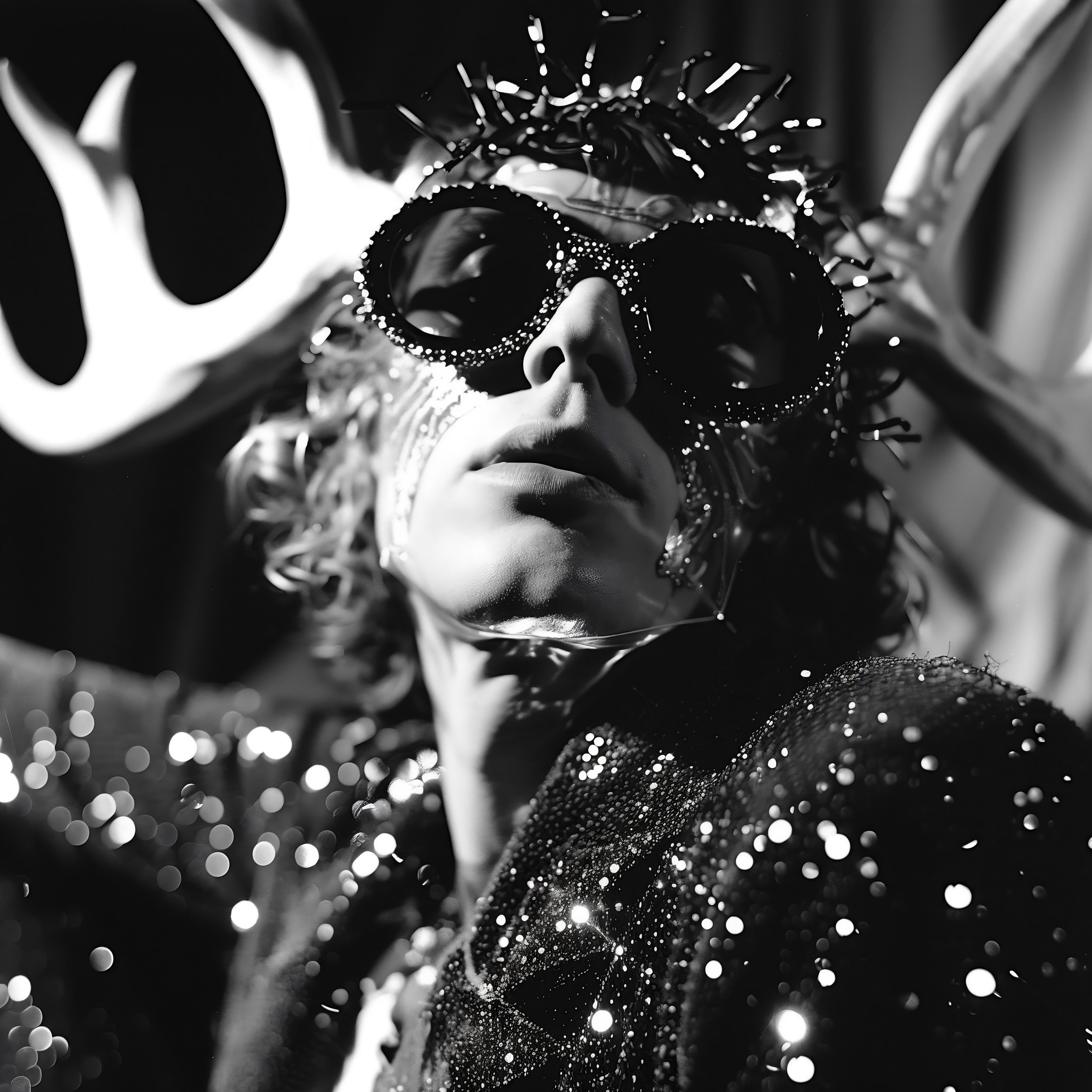
John Beckmann’s The Mortal Prophets has never operated like a traditional band. Instead, it feels more like a moving constellation — a project where avant-garde composition, Americana ghosts, and noir electronic atmospheres collide under shifting lunar light. With Hide Inside The Moon, Beckmann delivers one of the most immersive chapters yet: a psychedelic dream-pop album that doesn’t simply invite listening, but invites drifting. From the opening moments, Hide Inside The Moon establishes itself as a record suspended between worlds. Synths shimmer like heat mirages, guitars blur into prismatic afterimages, and voices appear and dissolve like echoes traveling across vast dream distances. Beckmann’s cinematic sensibility — shaped by his background in visual art and design — is everywhere. These songs unfold like staged scenes: half-remembered deserts, neon-lit streets, red-curtained dream stages where reality frays at the edges.

Two new vocal presences, Tanner McGraw on lead and Lawson Mars on backing vocals, bring a spectral intimacy to the album. Their voices don’t dominate so much as haunt the songs, glowing briefly before dissolving back into the haze. It’s an inspired choice that deepens the record’s atmosphere, giving it the fragile emotional clarity of Robert Wyatt’s later work while maintaining the playful, haunted drift of Syd Barrett-era Pink Floyd. The tracklist reads like a surrealist poetry collection, and the songs live up to that promise. “Mad Girl’s Love Song (Sylvia Plath)” carries literary melancholy into dream-pop reverie, while “Desert Of No End (Cy Twombly)” draws inspiration from visual art, mirroring Twombly’s mythic scrawls in sound — restrained, eruptive, and emotionally raw. Beckmann’s lyrical approach favors suggestion over confession, drawing from Romantic poetry, mysticism, and beat-adjacent surrealism, making each track feel like a dispatch from the subconscious.
There’s also a distinct noir current running throughout. Songs like “Blue Velvet” and “Devil Doll” conjure Lynchian torch-song surrealism, recalling Angelo Badalamenti’s lush melancholy without slipping into imitation. Even at its strangest, the album remains tender — psychedelia grounded not in spectacle, but in longing. Themes of doubled realities, time bending back on itself, and memory as invention ripple across tracks like “My Future Past” and the title song “Hide Inside The Moon.” Beckmann doesn’t just describe these sensations — he induces them. The record breathes rather than rushes, hovering in a soft, immersive hallucination that feels both intimate and cosmic. Hide Inside The Moon traces constellation lines between Cocteau Twins, Beach House, Mazzy Star, Vangelis, and kosmische ambient drift, yet it remains unmistakably Mortal Prophets: iconoclastic, poetic, restless, and deeply human. In the end, Hide Inside The Moon is less an album than a dream-space — a luminous unconscious you can step into and wander for a while. Beckmann and his rotating cast of collaborators have crafted a record that feels haunted by American folk tradition, unbound by nostalgia, and devoted to the strange beauty of transcendence.
website, spotify, soundcloud, youtube, instagram, x, facebook





 English